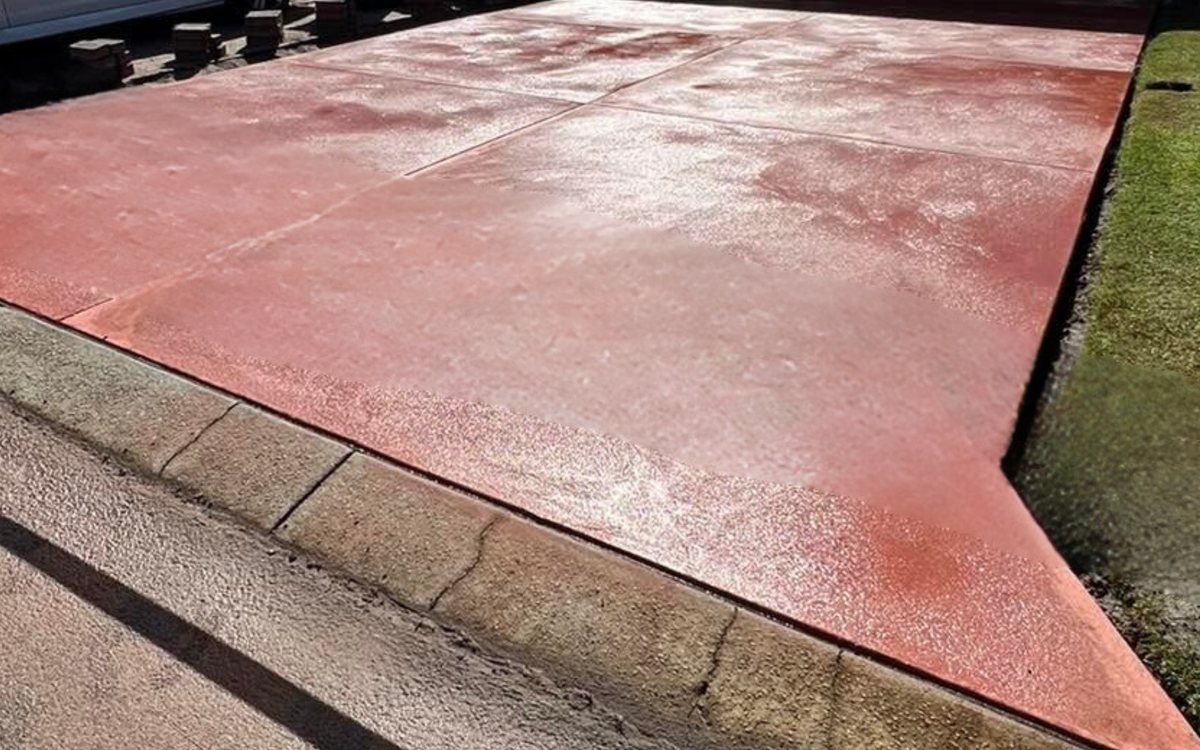
Resurfacing works when the slab underneath is sound, level and dry, and the only thing wrong with the driveway is its face: worn, flaking, stained or simply dated. It does not work when the slab is moving. Cracks with a lip, sections that have dropped, water that pools, edges that have broken away are all problems in the base, and a new surface laid over them follows them within a season or two. We replace driveways rather than resurface them, which means we have no product to sell you here, only the test that decides which one you need.
What resurfacing actually is
A resurfacing system is a thin overlay, usually a polymer modified cement a few millimetres thick, sprayed or trowelled over the cleaned and primed old concrete, sometimes stencilled or coloured, then sealed. Spray on finishes, trowelled overlays and epoxy flake coatings are all versions of the same idea. The point to hold onto is that it is a surface, not a structure. It adds appearance and some wear resistance. It adds no strength, no steel and no thickness that matters, and it cannot change the fall of the slab or the ground it sits on.
What it fixes well
On the right slab a resurfacing job does what it promises. Surface wear from years of tyres and weather, shallow flaking where the original finish was weak, oil and tannin stains that no amount of pressure washing shifts, a 1980s colour that fights the rendered house it now belongs to: those are surface faults, and an overlay covers them. Fine hairline crazing that is tight on both sides and has not moved in years is generally covered too, with the cracks filled first.
The conditions are not negotiable. The slab has to be solid, with no hollow sounding areas, no rocking sections and no live cracks. The old surface has to be ground or cleaned back so the overlay bonds, and the slab has to be dry through. Suppliers such as Dulux Avista say the same thing in their own words: how long the new surface lasts is decided by the condition of the concrete under it.
What it cannot fix
Most of the tired driveways we look at on the coast are not candidates, and the reasons are below the surface. Older beach side slabs from Golden Beach to Maroochydore were often poured thin on sand that was never compacted, so the kerb end has dropped and the edges have broken. Low lying streets hold water after a wet season and the base softens in patches. Hinterland and Caboolture clays move between seasons. Tree roots lift a slab a little more every year. In every one of those cases the crack is a symptom, and an overlay is a fresh surface for the crack to come back through.
The other things an overlay cannot change: falls that send water toward the house, a driveway too narrow for the cars it now carries, a slab with no steel in it, and a crossover the council treats as non compliant. Our guide to cracks, repair and replacement goes through how to read the slab itself.
What it costs next to a new slab
This is where the decision usually turns. A national cost guide puts concrete resurfacing at roughly $100 to $150 a square metre, with preparation of the old surface on top of that, and decorative finishes above it again. Our published rates guide puts a new plain concrete driveway, supplied and laid on a compacted base with steel mesh, at the bottom of a range that starts at $100 a square metre, with removal of the old slab itemised separately. Resurfacing prices vary a great deal between systems and operators, so treat those figures as the shape of the comparison rather than a quote. The shape is the point: on a slab that is sound, resurfacing is the cheaper way to a new look. On a slab that is not, you can spend close to the price of a new driveway on a finish that is carried by a failing base.
How long it lasts
Trade sources commonly put a professionally applied resurfacing at somewhere around eight to fifteen years, against decades for a new slab, and every one of them adds that the figure depends on the concrete underneath and on upkeep. On the coast, full sun, salt air and summer rain work any sealed surface hard, so a resurfaced driveway needs resealing on a shorter cycle than a new broom finished slab, which needs none. Our guide to sealing concrete on the coast covers the cycle.
The test
Resurface when the slab is level, sounds solid, drains away from the house, has no cracks with a step in them, and the only complaint is how it looks. Replace when sections have dropped, when cracks have a lip or are widening, when water sits on it, when the edges are breaking away, when the driveway is too thin for a caravan or boat that now parks on it, or when it needs to be wider. If the slab is in the first group, a resurfacing specialist is the right call and we will tell you so at the site measure. If it is in the second, an overlay is money spent twice.
What replacement involves
The old slab comes out and is disposed of as a line on the quote. The base is rebuilt and compacted, falls are set so water leaves the driveway, mesh goes in on chairs and the concrete is poured at the thickness the use demands, with control joints cut so the new slab moves at the joints rather than across the field. The build standard publishes those numbers. If the replacement changes the crossover at the kerb, Sunshine Coast Council treats that as new construction and its checklist applies; a like for like replacement inside the boundary does not. A replacement concrete driveway is quoted per square metre, supplied and laid, after a site measure, and the written quote is fixed.
What it costs
- Concrete driveways: $100 to $150 per m², supplied and laid
- Plain concrete: $100 to $110 per m², supplied and laid
Every range is published on the rates guide. Prices may vary with site conditions and variations; the written quote after a site measure is fixed.
Location pages this guide applies to: Nambour, Caloundra, Golden Beach, Maroochydore, Buderim, Caboolture.