A hairline crack that has not moved, has no lip and sits near a corner or a joint is cosmetic, and a driveway can live with it for decades. A crack you can fit a coin into, a slab that has dropped at the kerb, a section that rocks under a car or an edge that has lifted means the base or the steel beneath has failed, and the honest answer is replacement. The surface is only ever as good as what is under it.
Reading the crack
Concrete shrinks slightly as it cures, and it moves with temperature. Control joints are cut into a slab to give that movement a place to happen, and a fine crack that follows a joint is the joint doing its job. Hairline cracks across a slab that are tight, level on both sides and not growing are shrinkage cracks, common on older driveways that were poured without enough joints, and they are not a structural problem.
The cracks that matter are the ones with movement. A step where one side sits higher than the other means the ground has settled or heaved. Cracks that run right across the slab, widen over a year or come with sunken sections mean the base has moved. Crumbling edges and surfaces that flake show thin concrete or a weak surface. Water pooling where it used to drain means the falls have gone.
Why coast driveways fail
Most of the driveways we replace were poured thin, decades ago, with little or no steel, on sand that was never compacted. Beach side suburbs from Golden Beach to Maroochydore sit on sand that drains quickly but settles under a slab unless it is compacted first, so the edges and the kerb end drop. Low flat suburbs like Mountain Creek hold water after a big wet, which softens the base in patches. In the hinterland and south around Morayfield, clay and alluvial soils move between seasons. Tree roots lift paths and driveways everywhere. None of that is fixed by filling the crack, because the crack is the symptom.
What a repair can and cannot do
Filling hairline cracks keeps water out of them and tidies the look; it is a reasonable thing to do on a sound slab. Grinding a small lip at a joint removes a trip hazard. Beyond that the options get expensive for what they deliver. Resurfacing overlays a thin new surface on the old slab, which looks good until the old slab moves again, which it will if the base is the problem. Slab jacking pumps material under a sunken section to lift it; it can work where the ground has finished settling, and not where it has not. We do not resurface or jack slabs, so this is not a sales pitch for either; it is the reason we are often the second call.
What replacement involves
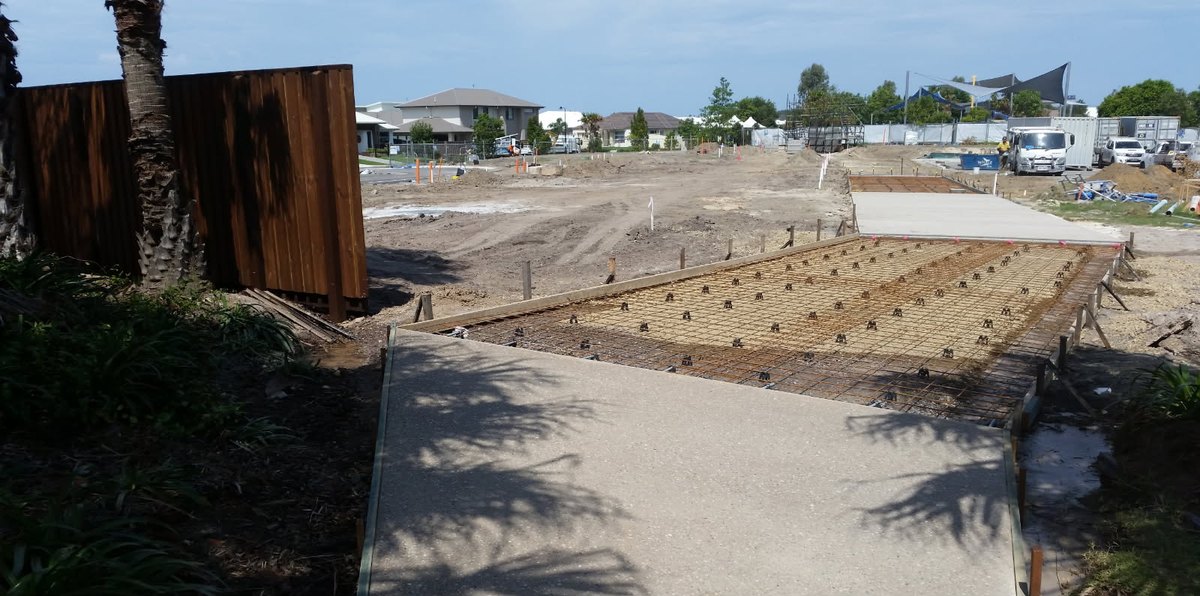
Replacement starts by taking the old slab out and disposing of it, which is itemised in the quote rather than appearing as a variation. The base is then rebuilt: organic material and soft spots removed, crushed rock or sand brought in and compacted, falls set so water leaves the driveway and the house. Steel mesh goes in on chairs so it sits inside the slab, and the concrete is poured at the thickness the use demands, typically 25 MPa at around 100 millimetres for passenger cars and thicker where a caravan or a boat will park. Control joints are cut at the right spacing so the new slab has somewhere to move. The build standard publishes those numbers.
One thing people are surprised by: if the replacement changes the crossover at the kerb, its width, surface or profile, Sunshine Coast Council treats that as new construction and the crossover checklist applies. Replacing like for like within your boundary does not. Which applies is settled at the site measure.
Repair or replace: the decision
Repair when the slab is sound, level and simply marked. Replace when there is movement, when sections have dropped, when the surface is failing across a wide area, or when the driveway is too narrow for the cars it now has to carry, which is often the real reason the call gets made. A replacement concrete driveway is priced per square metre, supplied and laid, with removal as a separate line, and the ranges are published on the rates guide so the decision can be made with real numbers rather than a guess.
What it costs
- Concrete driveways: $100 to $150 per m², supplied and laid
Every range is published on the rates guide. Prices may vary with site conditions and variations; the written quote after a site measure is fixed.
Location pages this guide applies to: Caloundra, Maroochydore, Mountain Creek, Golden Beach, Morayfield.