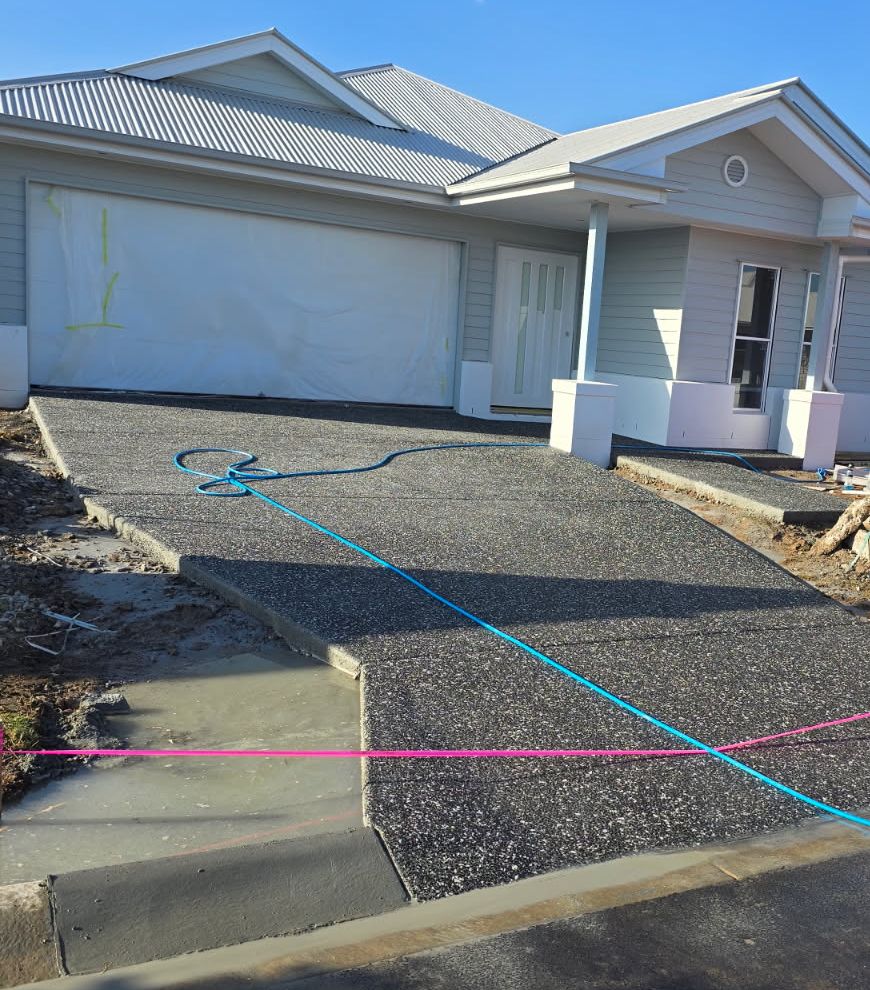
The short answer: on the Sunshine Coast a standard residential crossover needs no permit, and a non standard one needs the council’s written approval before any concrete is poured. The crossover is the section of driveway between your property boundary and the road, and because it sits on council land it follows council rules even though you pay for it. Everything inside your boundary is yours to decide.
What a crossover actually is
Your driveway has two parts. The slab inside your boundary is private property. The strip from the boundary to the kerb, across the verge and footpath, is the crossover, and it sits in the road reserve. Councils care about the crossover because it crosses public footpaths, stormwater pits and street trees, and because a badly built one becomes the council’s problem to fix.
That split matters when you compare quotes. A quote for a concrete driveway should say whether it includes the crossover, because the crossover is built to a council standard drawing rather than to taste, and the section at the kerb can be the most awkward part of the job.
Sunshine Coast Council: standard or non standard
Sunshine Coast Council runs a two tier system. The council publishes a crossover checklist. If your crossover answers yes to every item, it is standard: you can self assess it and build it, with no permit and no fee, to the council’s nominated standard drawings. At the time of writing those are IPWEA drawings RSD-100 and RSD-101 for urban streets and RS-056 for rural roads.
A single no on the checklist makes the crossover non standard, and that needs formal written approval from the council before work starts. The application carries a fee set by the council each financial year, listed at $680 for a non standard vehicle crossover in the 2026-27 fees register. Fees are the council’s and can change, so treat that figure as a guide, not a quote.
The checklist items that trip people up most often:
- Clearances. A crossover needs to sit clear of stormwater pits and power poles, well back from bus stop approaches, and away from easements, manholes, water meters, hydrants and NBN pits.
- Corner blocks. Access is expected from the street the house is addressed to.
- Materials. Urban crossovers are concrete, which includes coloured and exposed aggregate, or asphalt. Raised stamped patterns are not accepted.
- Width and position. The crossover has to line up with the council drawing for your street type.
One point worth knowing: the council treats any change to an existing crossover’s profile, surface, size or materials as construction. Widening the driveway at the kerb for a boat or a second car is a new crossover in the council’s eyes, so the checklist applies again. Crack repairs and sealing are exempt.
Noosa Shire: the same model, stricter terms
Noosa Shire also runs a checklist, with a standard crossover needing no permit and a non standard one needing written approval through the council’s planning department, with a fee the council sets each year (a $700 base fee in 2026-27). The differences are in the detail. The surface must be concrete, including coloured and exposed finishes, or asphalt; pavers, tiles and loose stone are not accepted. The slab runs full width from kerb to boundary with no wheel tracks. A property with a second crossover is non standard by definition. And the shire expects whoever builds the crossover to hold public liability insurance of at least $20 million for work outside the boundary, which we hold.
Noosa still references the older drawing numbers, RS-049 and RS-050 for urban streets and RS-056 for rural, so a quote for a Noosa crossover should name those.
Caboolture and Morayfield: City of Moreton Bay
South of the coast the rules change again. In the City of Moreton Bay the property owner self assesses the crossover against the accepted development requirements in the council’s planning scheme, and those requirements differ by zone, so a general residential street and a rural residential block are measured against different lists. A compliant crossover needs no application. One that falls outside the requirements is referred to the council for assessment, a fee applies, and the council is explicit that construction must not begin until its written approval arrives. The council also treats the work as the owner’s responsibility and risk.
State controlled roads
If your frontage is on a state controlled road, the Bruce Highway service roads and some of the main connectors, the crossover is the Department of Transport and Main Roads’ business, not the council’s. That is a different application and a slower one, and it is identified at the site measure.
What a crossover costs
A standard crossover carries no council fee on the Sunshine Coast or in Noosa. The concrete itself is priced the same way as the rest of the driveway, per square metre, supplied and laid, with the published ranges on the rates guide. What moves the crossover’s share of the price is width (a double garage crossing is wider than a single), the kerb detail, whether a footpath section has to be cut out and poured through, and, for a non standard crossover, the council’s application fee. Every one of those is itemised in the written quote rather than appearing on the day.
Who can build it
Sunshine Coast Council lets the owner build their own crossover and does not require a contractor, though it takes no liability for the result. In practice a crossover is formed, poured and finished to a standard drawing at the kerb, in the road reserve, around services, and a mistake is the owner’s to fix. Noosa’s insurance condition settles the question there. The approach that works: the crossover is checked against the checklist at the site measure, the quote states which tier it falls in, and nothing is formed until that is settled. The build standard sets out what sits under the slab on either side of the boundary.
What it costs
- Concrete driveways: $100 to $150 per m², supplied and laid
Every range is published on the rates guide. Prices may vary with site conditions and variations; the written quote after a site measure is fixed.
Location pages this guide applies to: Caloundra, Buderim, Maroochydore, Mountain Creek, Sippy Downs, Noosa, Peregian Beach, Caboolture, Morayfield.