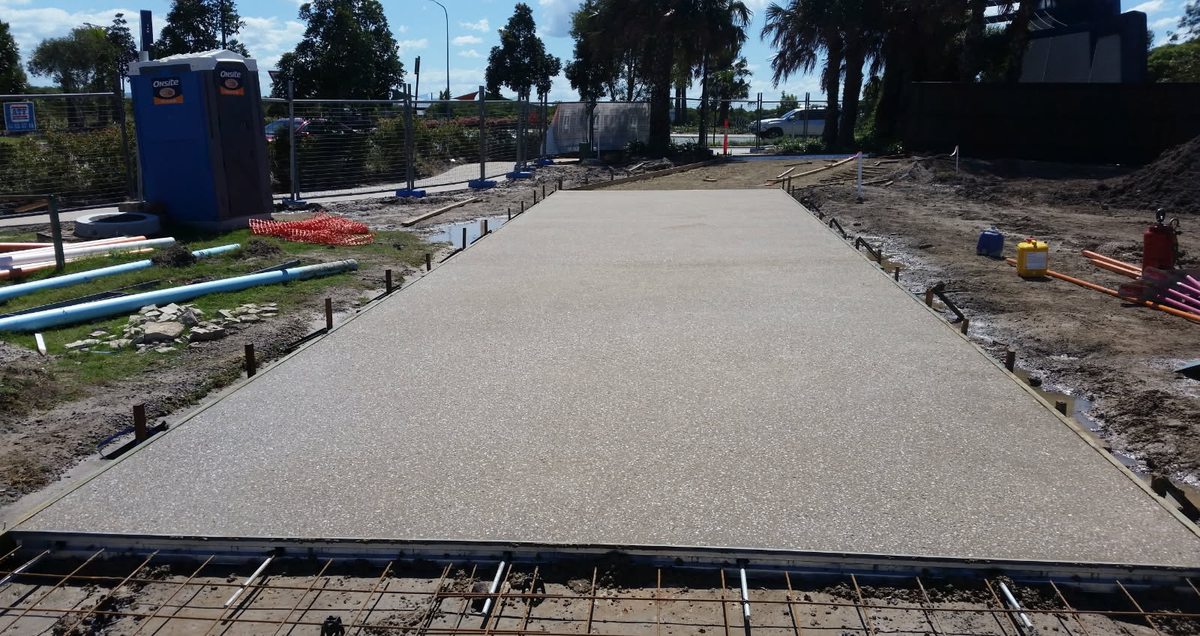
New concrete is sealed once it has cured, not when it is poured, and on the Sunshine Coast that first seal matters more than it does inland. The sealer stops UV fading the colour, stops oil, tannin and salt getting into the surface, and keeps the stone in exposed aggregate looking wet and deep. It is then renewed every few years, sooner around a pool and on a frontage that bakes all afternoon.
What a sealer actually does
Concrete is porous. Left bare, it drinks whatever lands on it: oil off the car, tannin from leaves, red dust, pool water, salt carried in on the breeze. Sun breaks down the cement paste at the surface and fades pigment. A sealer closes the surface against all of that. On plain grey concrete it is optional and mainly about stains. On coloured concrete it protects the colour. On exposed aggregate it is part of the finish: without it the stone goes dull and the paste between the stones weathers.
The two kinds
Film forming sealers, usually acrylic, sit on top of the surface and give the wet look that makes exposed aggregate and coloured concrete glow. They are the usual choice for decorative finishes, they are what wears and they are what gets reapplied. Penetrating sealers soak into the concrete and seal it from within without changing the look; they suit plain concrete and anywhere a natural, matte finish is wanted. Around pools and on honed surfaces the sealer is chosen for wet feet first and appearance second, and a slip resistant additive is used where a film sealer would otherwise be too smooth.
When new concrete can be sealed
Not straight away. Concrete keeps curing for around a month, and sealing too early traps moisture under the film and leaves it cloudy. Exposed aggregate is washed back on the day, left to cure, then sealed once the surface is dry and clean, commonly around a month after the pour depending on the weather. Coloured concrete follows the same pattern. The seal goes on in dry conditions, out of the heat of the day, because a sealer applied to a hot slab flashes off before it bonds.
How often to reseal on the coast
The interval depends on traffic and sun. A driveway in full northern sun that carries two cars a day will want resealing sooner than a shaded side path. As a guide, exposed aggregate and coloured driveways on the coast are resealed every few years; pool surrounds, with chlorine or salt water on them and bare feet across them, sooner. The surface tells you: when water stops beading and the colour goes flat, it is time. We cover the reseal interval for your surface at handover.
Does sealing make it slippery
It can, if the wrong sealer goes on the wrong surface. A glossy film sealer on a smooth trowelled slab is slippery when wet. On a broom finish or exposed aggregate the texture does the gripping and a sealer does not take that away. On honed concrete and around pools, the sealer is a matte product with a slip resistant additive. Sealing a driveway correctly leaves it as grippy as it was; it is the pool surround and the alfresco where the choice has to be deliberate.
Doing it yourself versus having it done
Resealing a driveway is within reach of a careful owner with the right product, a clean dry surface and a cool morning. The failures we see are the predictable ones: sealer on a damp slab, sealer in the midday sun, sealer over dirt, or a new sealer that does not match what was used before, which peels. If the surface is exposed aggregate or a pool surround, having it done is cheaper than having it stripped and redone.
Sealing and the quote
A new exposed aggregate driveway or pool surround is quoted with the first seal included in the finish, and a plain concrete driveway can be quoted with or without one. The ranges are published on the rates guide, and the care and reseal intervals for your surface are covered at handover rather than left to a guess.
What it costs
- Exposed aggregate: $135 to $150 per m², supplied and laid
- Pool surrounds: $120 to $180 per m², supplied and laid
- Concrete driveways: $100 to $150 per m², supplied and laid
Every range is published on the rates guide. Prices may vary with site conditions and variations; the written quote after a site measure is fixed.
Location pages this guide applies to: Golden Beach, Peregian Beach, Mooloolaba, Kawana, Coolum, Noosa.