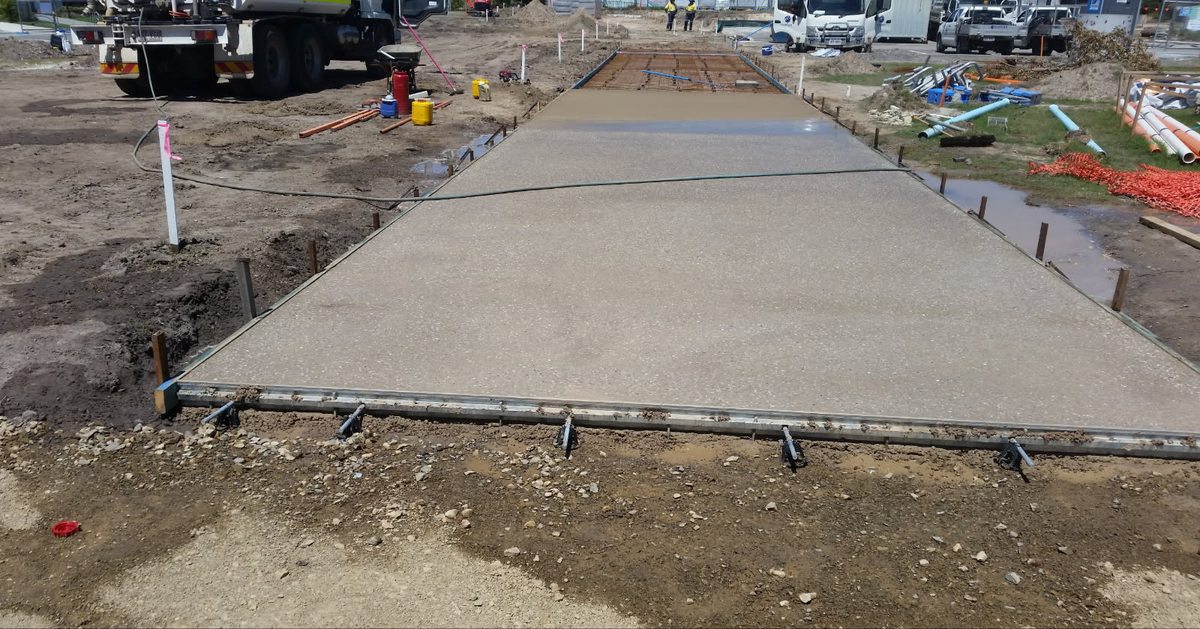
Light rain before a pour is fine, provided the base and the forms are in order. Rain during placing and finishing is not: it washes cement paste off the surface, weakens the top of the slab and leaves a surface that dusts and flakes. Rain in the first hours after finishing marks the surface. So the answer is that a pour is scheduled around rain, not poured through it, and on the Sunshine Coast that means watching the radar and, in summer, pouring early.
What rain does at each stage
Before the pour, rain on a prepared base is mostly a nuisance. A compacted base sheds water; standing water is pumped off, soft spots are re-compacted, and the pour goes ahead. During the pour, rain is the problem. Fresh concrete is a careful balance of cement, water and aggregate, and extra water on the surface while it is being placed and floated dilutes the paste at the top, which is the part you walk and drive on. After finishing, the first few hours are the window where rain pits and marks the surface. Once the concrete has set, rain is harmless and mild wet weather actually helps curing.
Heat is the quieter problem
On the coast, heat does more damage to more slabs than rain does. Australian Standard 1379 requires concrete to be delivered between 5 and 35 degrees, and the industry guidance is to take precautions once the air is above about 30 degrees, especially with a dry wind. The issue is evaporation: when water leaves the surface faster than the concrete can replace it from below, the surface shrinks before it has strength and cracks in a fine map pattern. The guidance threshold is an evaporation rate of about a kilogram of water per square metre per hour, which a hot, windy coast afternoon can reach easily.
The response is practical. Pours start early, often at first light in summer, so placing and finishing are done before the heat. Mixes are ordered to suit the day. The surface is kept damp and cured properly rather than left to dry. A slab finished at midday in January with no curing is how a brand new driveway ends up with hairline cracks across it.
The wet season and the dry
The coast gets its rain in summer, often as afternoon storms from November through March, and its best concreting weather in the dry months. That does not mean winter only. It means summer pours are morning pours, that a storm forecast for the afternoon moves the start forward rather than cancelling the day, and that a day with rain forecast through the morning is rescheduled. The call is made the evening before and again at first light; forms do not mind waiting a day.
Curing: the part nobody sees
Curing is not drying. Concrete gains strength through a chemical reaction with water, and it needs to keep that water for the first week. Industry guidance is to cure for at least seven days, and that is what the slab gets, by keeping the surface damp or by applying a curing compound. A slab that is allowed to dry out in the first days is weaker and more prone to surface cracking, which is why a pour that looks finished at lunchtime is not finished.
When you can use it
Foot traffic is fine after about 24 hours. Cars after seven days. Concrete reaches most of its design strength at around 28 days and keeps gaining a little after that, so heavy vehicles stay off for as long as you can manage, and the edges, which are the last to come up to strength, are treated gently for the first month. Exposed aggregate is washed back on the day and sealed once cured, commonly around a month later; our guide to sealing concrete on the coast covers the timing.
What this means for booking
A pour date is a plan, not a promise against the weather. The site measure sets the scope and the fixed written quote; the pour is scheduled for a run of suitable weather, with summer jobs set for mornings, and moved if the forecast turns. That costs a day occasionally and it is cheaper than a slab poured in a storm. The numbers a concrete driveway or an alfresco slab is poured to are on the build standard, and the ranges on the rates guide.
What it costs
- Concrete driveways: $100 to $150 per m², supplied and laid
- Patios and alfresco slabs: $100 to $150 per m², supplied and laid
Every range is published on the rates guide. Prices may vary with site conditions and variations; the written quote after a site measure is fixed.
Location pages this guide applies to: Nambour, Landsborough, Maleny, Morayfield, Palmview, Beerwah.